BLOG |
Compliance

Published:
September 4, 2026
Last updated:


Most compliance failures in Southeast Asia do not happen because of ignorance of the law; rather, they come from a reasonable assumption that a regional HR policy can carry across five markets in the same region.
Malaysia, Indonesia, the Philippines, Vietnam and Thailand sit within a few hours of each other, but their employment frameworks descend from different sources, resolve disputes in different forums, and price the same management decision very differently. Ending one employment relationship can cost a fortnight's pay in one market and more than a year's pay in another. The regulations also change frequently and often with minimal warning.
This divergence is structural rather than cosmetic, and therefore where it costs money.
Malaysia is governed by the Employment Act 1955 as amended in 2022 and the Industrial Relations Act 1967. The Philippines runs on a Labor Code in which security of tenure has constitutional standing. Indonesia and Vietnam are civil law systems, the first working from the Manpower Law 13/2003 as amended by the Job Creation Law 6/2023, the second from the Labour Code 2019 alongside a new Social Insurance Law and Employment Law. Thailand operates under the Labour Protection Act B.E. 2541 and its amendments.
Thailand permits termination without cause. An employer can end the relationship without establishing fault, provided severance is paid on the statutory ladder, which runs from 30 days' wages at 120 days of service up to 400 days' wages at twenty years. Notice pay sits on top of that. Unfair dismissal claims remain available in the Labour Court, but the baseline position is that ending employment is a priced decision rather than a contested one. Thailand is cheap to hire into and expensive to leave.
The other four markets do not work that way, and each fails differently.
In Malaysia, dismissal requires just cause or excuse. Retrenchment triggers a benefit of 10 to 20 days' wages per year of service for Employment Act employees, banded by tenure, and the Industrial Court can order reinstatement with back wages where the dismissal does not stand up.
Indonesia prescribes both the grounds and the route. A termination moves through bipartite negotiation, then mediation, then the Industrial Relations Court. The exit package combines severance pay, long service pay and compensation of rights under the formula set out in PP 35/2021.
The Philippines allows termination only for just cause or authorised cause, and requires the twin-notice procedure with a genuine opportunity to be heard. Separation pay applies to authorised causes at one month, or between half a month and one month per year of service depending on the ground, whichever is higher. The point foreign employers most often miss is that a dismissal which is substantively justified but procedurally defective is still actionable, and a finding of illegal dismissal carries reinstatement plus full back wages.
Vietnam is the market most often misread in the opposite direction. The severance formula, half a month per year of service, is offset by periods covered by unemployment insurance, and because that insurance has covered most employees since 2009 the actual financial liability for a recent hire is frequently close to nothing. The exposure sits in the process instead. Lawful grounds for termination are a closed statutory list. Terminate on a ground that is not on that list and the termination is void, regardless of what was paid.
Malaysia is the only one of the five where a single salary band applies throughout the whole country. The national rate has been RM1,700 per month since February 2025 and has applied to every employer without exemption since 1 August 2025.
Everywhere else, the floor is a function of location, and the location that counts differs by market. Indonesia sets a provincial rate and, in most cases, a city or regency rate on top of it. The 2026 range runs from roughly Rp 2.19 million to Rp 5.73 million under PP 49/2025, with Jakarta rising 6.17 percent. Paying to the provincial figure alone is not sufficient wherever a city rate exists.
Vietnam operates four regions, from VND 5,310,000 in Region I to VND 3,700,000 in Region IV, effective 1 January 2026 under Decree 293/2025. The applicable rate follows the employer's operating location rather than the employee's home address, which is the reverse of the Indonesian and Philippine position and a reliable source of error for distributed teams. A separate detail catches foreign-invested enterprises regularly: an employee holding certified vocational training must be paid at least 7 percent above whichever regional floor applies.
Thailand sets a daily rate by province, currently in the range of THB 337 to THB 400, with Bangkok at the top. The Philippines runs seventeen regional wage boards with sectoral tiers, and the Metro Manila order is presently before the courts, covered in the change log below.

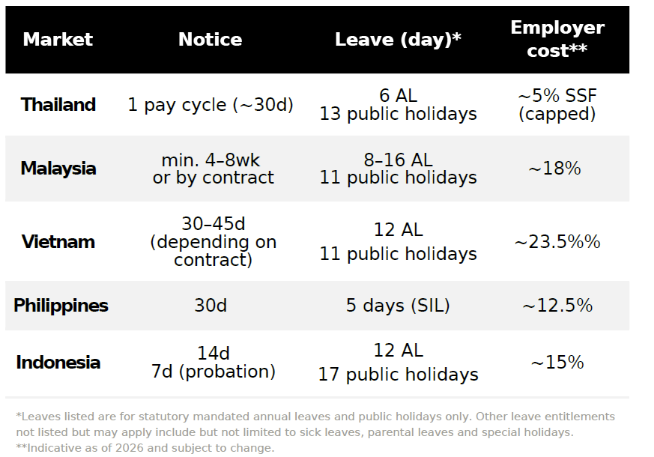
Vietnam carries the heaviest statutory load of the five, at around 21.5% for social, health and unemployment insurance, plus a 2 percent trade union fee. Malaysia follows, driven largely by EPF at 13% of monthly wages up to RM5,000 and 12% for wages above that, with SOCSO and EIS on a RM6,000 cap. Non-Malaysian employees entered EPF from October 2025 wages at 2 percent from each side, which means any expatriate cost model written before that date now understates the position.
Indonesia and the Philippines both sit around 10 to 13%, and both cap. The Philippine ceiling across SSS, PhilHealth and Pag-IBIG is reached at roughly PHP 6,230 per employee per month. Thailand is the lightest by a wide margin: 5 percent from each side into the Social Security Fund, capped at a wage of THB 17,500 from 1 January 2026, plus a small workmen's compensation premium. At mid-level salaries that often lands under 2 percent of gross.
For senior hires, the capping matters more than the headline rate. Beyond a certain salary, Thai and Philippine employer cost flattens while Vietnam's continues to rise with gross pay, which reverses the intuitive cost ranking between those markets at the top of the band.
The most common budgeting error across the region is treating 13th month pay as optional. It is statutory in two of these five markets. In the Philippines, 13th month pay is mandatory for rank-and-file employees and due by 24 December each year, calculated as one twelfth of basic salary earned during the calendar year. In Indonesia the equivalent obligation is THR, at least one month's wage, pro-rated below twelve months of service and paid before the relevant religious holiday. Neither is a performance bonus, and neither can be withheld for performance.
Malaysia, Vietnam and Thailand have no statutory equivalent, though end-of-year bonuses are often customary and the lack thereof may result in lower retention. A regional headcount model built on gross salary plus a flat percentage will understate Indonesian and Philippine cost by roughly 8%.
Philippines. The probation period in the Philippines is capped at six months, and the standards for regularisation must be communicated to the employee at engagement. Where they are not, the employee is treated as regular from day one, with full security of tenure. This is the single most frequent documentation failure we see from foreign employers in the market. On exit, the notice period in the Philippines depends on the ground: authorised causes such as redundancy or closure require 30 days' written notice to both the employee and the Department of Labor and Employment, while just cause dismissals follow the twin-notice procedure rather than a fixed notice period.
Indonesia. The probation period in Indonesia is capped at three months and permitted only in a permanent contract. Applying one to a fixed-term contract is void, and the practical consequence is that the employee is treated as permanent. Under PP 35/2021 the notice period in Indonesia is at least 14 working days of written notice before a termination takes effect, reduced to 7 working days during probation.
Vietnam. The probation period in Vietnam runs to 60 days for most roles and 180 days for enterprise managers. An employer may use two consecutive fixed-term contracts; the relationship becomes indefinite on the next renewal, whether or not that was the intention on either side. The notice period in Vietnam is set by contract type under the Labour Code 2019: 45 days for an indefinite-term contract, 30 days for a fixed-term contract of 12 to 36 months, and 3 working days for a fixed-term contract under 12 months.
Malaysia. An employment contract in Malaysia leaves the probation period uncapped by statute, with three to six months the norm, but probationary status does not remove the requirement of just cause or excuse for dismissal. The notice period in Malaysia is set by the Employment Act 1955 at 4 weeks for under two years of service, 6 weeks for two to under five years, and 8 weeks at five years or more, unless the employment contract provides a longer period. Payment in lieu of notice is permitted, and notice must be in writing. Statutory notice does not extend to probationers, so an employment contract in Malaysia should state the probationary notice period explicitly rather than leave it to be inferred.
Thailand. Thailand does not recognise a probation period as a statutory concept at all. Once an employee passes 120 days of service, the severance ladder applies regardless of what the contract calls the period. The notice period in Thailand is not a fixed number of days either: under section 17 of the Labour Protection Act, notice given on or before a wage payment date takes effect on the next one, which for monthly-paid staff means up to a full pay cycle. Payment in lieu is permitted.
Statutory leave in these five markets is not close enough to standardise at one level. Thailand moved to 120 days of maternity leave and introduced 15 days of paid paternity leave under the Labour Protection Act (No. 9) B.E. 2568, in force 7 December 2025. Vietnam provides six months. The Philippines provides 105 days. Indonesia provides three months, extendable to six with medical certification under the KIA Law 4/2024, with full pay for the first four months and 75 percent for months five and six. Malaysia provides 98 days and 7 days of paternity leave.
Annual leave diverges just as sharply, from a statutory minimum of five days of service incentive leave in the Philippines and six days in Thailand, up to twelve days in Indonesia and Vietnam and a tenure-banded 8 to 16 days in Malaysia.
Setting one regional parental leave policy at the lowest statutory level leaves you non-compliant in Vietnam and Thailand. Setting it at the highest is compliant everywhere and expensive. The workable answer is a regional principle with country schedules attached, reviewed annually.
One cost note that is easy to overlook: in the Philippines and Vietnam the maternity benefit is funded by the state insurance scheme rather than the employer. In Malaysia and Thailand the employer carries part of it directly. Two markets with similar headline entitlements can therefore have very different employer costs.
The useful division is not by function but by audience. Standardise the things that reflect how you want to operate as a company. Localise anything a regulator or a labour court will read.
Safe to standardise across the region: job architecture and grading, the performance and review cycle, compensation philosophy and banding logic, discretionary benefits and allowances, learning and development, code of conduct and escalation principles, and remote and hybrid working principles.
Must be localised market by market: employment contract templates, the probation period and confirmation process, statutory contributions and wage floors, 13th month pay and equivalent provisioning, the termination process and its documentation, severance accrual, notice periods, and leave schedules.
The line between the two lists is worth defending in planning discussions, because pressure usually runs one way. Regional consistency is easy to argue for and the cost of getting it wrong surfaces late, usually at an exit.
There is no single Southeast Asian rulebook, and no shortcut to operating as though there were. What there is, for a team expanding across three to seven markets, is a workable division of labour: standardise the things that express how you want to run, and localise the things that will be assessed by someone other than you.
AYP employs directly through our own entities across major APAC markets, with local teams who track these changes as they happen rather than at annual review. If you are budgeting headcount across any of these five markets for 2027, we can walk you through the current position market by market.
Indonesia and the Philippines, on process rather than cost. Indonesia requires a staged dispute path before a termination can be concluded, and the Philippines exposes procedurally defective dismissals to reinstatement and full back wages regardless of the underlying merits. Thailand carries the highest headline severance but the most predictable path.
No. An employer of record holds the employment contract on a local entity and carries the statutory obligations. What matters is whether your provider operates through its own entity in that market or through a partner, and whether it will tell you which.
No. It is statutory in the Philippines and, as THR, in Indonesia. In Malaysia, Vietnam and Thailand it is customary and often contractual, which means it may still bind you through your offer letters and handbook even where the law does not require it.
Constructive dismissal treats an employee's resignation as a dismissal by the employer, on the basis that the employer's conduct made continued employment untenable. The doctrine is most developed in Malaysia, where claims are heard by the Industrial Court, and in the Philippines, where it is established in jurisprudence and typically arises from demotion, pay reduction or unreasonable working conditions. Indonesia, Vietnam and Thailand reach comparable outcomes through different mechanisms. In all five, a unilateral change to pay, role or location is the most common trigger.
There is no common figure. The notice period in Malaysia runs from 4 to 8 weeks depending on length of service. In Vietnam it is 45 days for indefinite-term contracts and 30 days for fixed-term contracts of 12 to 36 months. In Indonesia it is at least 14 working days. In the Philippines, authorised cause dismissals require 30 days' notice to the employee and to DOLE. In Thailand it is effectively one pay cycle. Payment in lieu is available in some but not all of these markets, so check before assuming it.
The probation period is capped at six months in the Philippines, three months in Indonesia, and 60 days in Vietnam, or 180 days for enterprise managers. Malaysia does not cap it by statute, though three to six months is standard. Thailand does not recognise probation as a statutory concept at all, and severance applies from 120 days of service regardless.