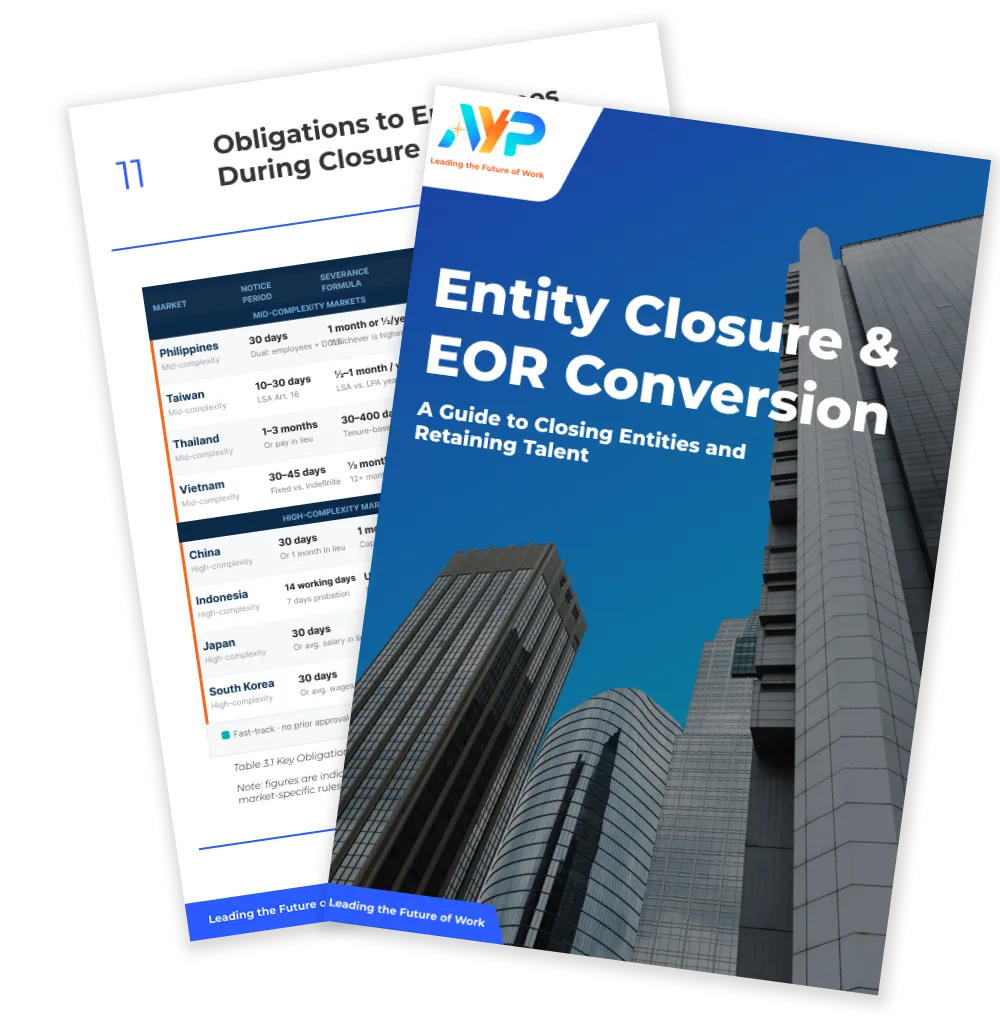
Entity Closure & EOR Conversion
How to Close a Legal Entity Across APAC Without Losing Your Team
A practical guide for regional HR leaders managing entity closure and EOR transition compliantly across one or more APAC markets.
What’s Inside
This guide covers why companies across APAC are closing legal entities without leaving their markets, what the closure process actually looks like across thirteen jurisdictions, and what employers owe employees at each stage. It walks through the EOR transition sequence: specifically, how to get employees onto new contracts before termination notices go out, and how to run closures across multiple markets without leaving gaps in employment coverage. There's also a market-by-market reference for closure timelines, severance formulas, notice requirements, and government approval thresholds.
Who Will Benefit

Regional HR Directors - for HR Directors and Heads of People managing entity closures across one or more APAC markets who need to meet their employer obligations, keep their people, and move to an EOR without payroll or compliance disruption.
Finance & Operations Leaders - for finance and operations stakeholders weighing the ongoing cost of local entities against a leaner regional structure that keeps commercial operations running with less overhead.
Legal & Compliance Teams - for general counsel and compliance professionals who need entity deregistration, employee terminations, and statutory settlements to happen in the right order, across multiple jurisdictions, without exposure.
Companies Restructuring Their APAC Footprint - for businesses consolidating legal entities or shifting their regional setup who need to close incorporated vehicles without losing the teams built inside them.
Global Mobility & Payroll Teams - for mobility and payroll professionals handling the handover of employee contracts, statutory contributions, and benefits from a closing entity to a new EOR across APAC markets.
What You’ll Learn
Why Companies Close — But Stay
Entity closure is not market exit. Four things tend to drive the decision: cost rationalisation, operational consolidation, a shift in business priorities, or geopolitical repositioning. The commercial presence and the team stay. The legal vehicle doesn't.
What Closure Actually Involves
Closure timelines across APAC range from three months to two years. Every market moves through the same broad phases: dissolution resolution, tax clearance, regulatory sign-offs, deregistration. The EOR transition has to run alongside this process, not after it. Waiting for the entity to close first creates an employment gap.
What You Owe Your Employees
Notice periods, severance formulas, final entitlements, and government approval requirements differ significantly across APAC's thirteen markets. The guide covers each one. The sequence matters too: in most markets, approval comes before notice, and notice before severance settlement.
How to Transition Employees to an EOR
Six steps take employees from the closing entity to the EOR: engage the provider, prepare contracts, get employee sign-off, issue termination notices, settle all entitlements, start the new contracts. Done in that order, the entity closes and the team keeps working.
Get Entity Closure & EOR Conversion Guide