The Year Ahead in APAC
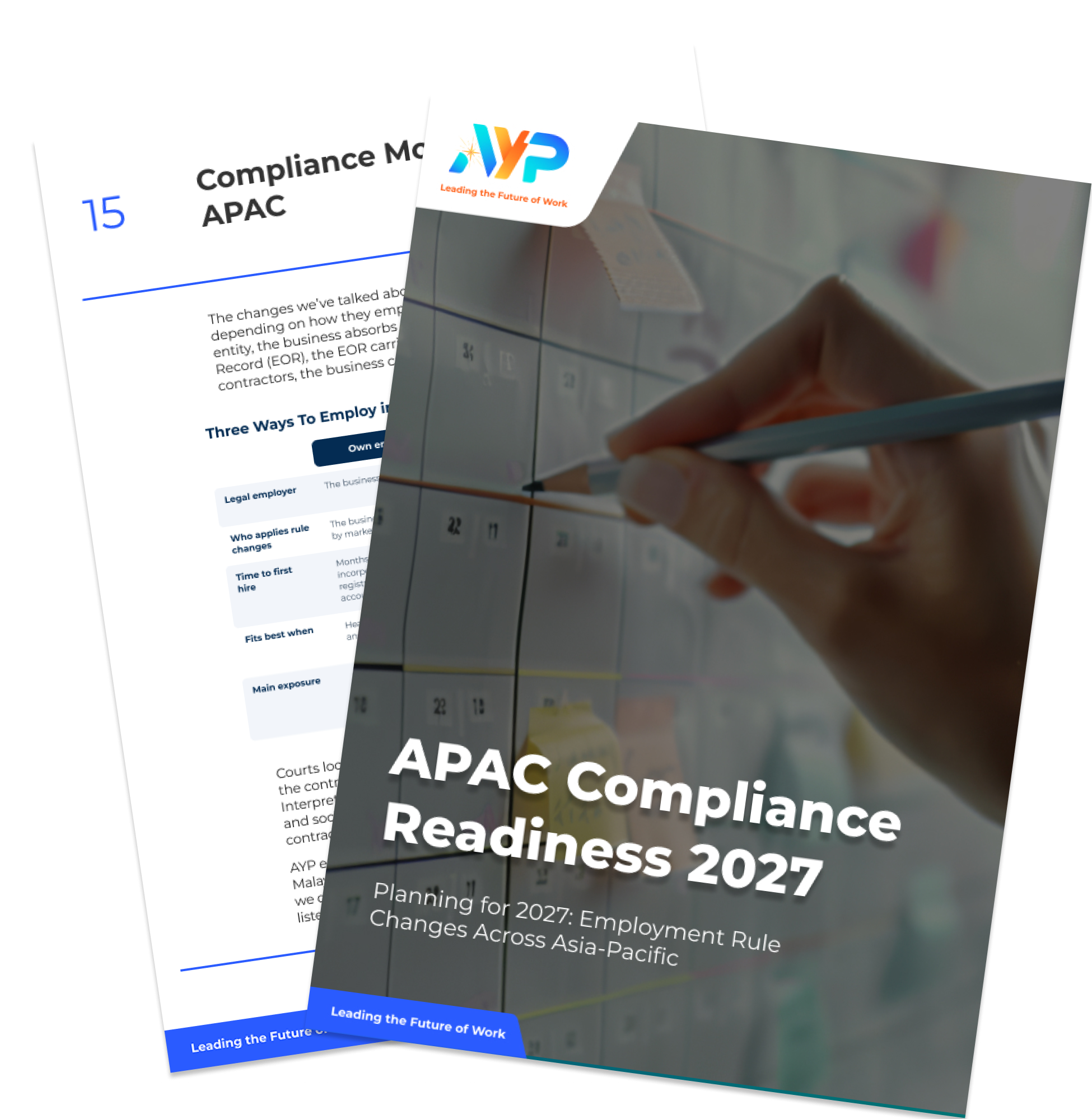
APAC Compliance Readiness 2027
What’s already changed, what’s coming in 2027, and how to plan for both across Asia-Pacific
What’s Inside
Across AYP's 13 APAC markets, 39 employment changes either apply now or are scheduled for 2027. Fourteen already apply. The other 25 are due in 2027: ten confirmed, ten announced and five still expected. For each one, this paper sets out what changes for employers and when it takes effect, grouped into wages and leave, statutory contributions, payroll and tax, contracts and termination, work passes, and employee data. It also explains why so many rules are moving at the same time, compares three ways to employ in APAC, and ends with a month-by-month 2027 compliance calendar. Rules are stated per market as published by each government at October 2026.
Who Will Benefit

Regional HR Directors - for HR Directors and Heads of People employing across several APAC markets who need every 2027 rule change in one place, by market and by date, before policies and headcount plans are set.
Finance & Payroll Teams - for finance and payroll leads budgeting 2027 employment costs, including Malaysia's RM2,000 minimum wage, Taiwan's 13% labour insurance rate and higher CPF rates for Singapore employees aged 55 to 65.
Legal & Compliance Teams - for legal and compliance professionals tracking rewritten employment frameworks, including Indonesia's new Labour Protection Law, India's four Labour Codes, Singapore's Workplace Fairness Act and Australia's proposed non-compete ban.
Global Mobility Teams - for teams hiring or relocating foreign staff who need to plan around Malaysia's Employment Pass succession plans, Singapore's S$6,000 qualifying salary and Japan's new Employment for Skill Development programme.
Companies Entering a New APAC Market - for businesses deciding whether to employ through their own entity, an Employer of Record or contractors, and who need to know which rule changes they would have to apply themselves.
What You’ll Learn
Why So Much Is Changing at Once
APAC has no regional framework, so each market changes its rules through its own institutions and on its own calendar. Most of the 39 changes trace back to the same few pressures: wage floors reset against living costs, social protection extended to more workers, older labour laws rebuilt, and labour shortages changing how companies hire foreign staff.
The 14 Changes Already in Effect
Four took effect in late 2025 and ten during 2026. Most are new rates and thresholds that payroll systems absorb. Three change who qualifies for statutory protection or contributions: Hong Kong's "468" continuous contract rule, mandatory EPF for foreign employees in Malaysia, and China's Supreme People's Court confirming that employees cannot opt out of social insurance.
What's Due in 2027 and How Firm Each Date Is
Each of the 25 changes due in 2027 is marked confirmed, announced or expected. The year has two peaks. On 1 January, new minimum wages are due in Taiwan, South Korea, Vietnam and Indonesia. In June, Malaysia's minimum wage is due to rise 17.65% to RM2,000 a month, with smaller businesses exempt. Indonesia's new Labour Protection Law has the widest reach of any change, and its details are still pending.
Three Ways to Employ and the 2027 Compliance Calendar
A comparison of own entity, Employer of Record and contractors: who the legal employer is, who applies rule changes, how long the first hire takes and where the main exposure sits. The paper closes with a month-by-month calendar showing when each 2027 change takes effect and when outstanding details are due.